

Razer’s latest push into Hall Effect keyboards delivered practically everything I wanted from a premium magnetic gaming keyboard, including adjustable actuation, Rapid Trigger, 8,000 Hz polling, Snap Tap, Snap Flex, and an impressive amount of control over how individual keys behave. I gave the Huntsman V3 HE Magnetic a 10/10, and I still stand behind that score.
That made the Razer Huntsman V3 Pro Low-profile Tenkeyless 8KHz particularly interesting because there is considerable overlap between the two. The Low-profile offers many of the same enthusiast-level technologies but builds everything around Razer’s Low-profile Analog Optical Switches instead of Hall Effect magnetic switches. I don’t think choosing between them is nearly as simple as assuming Hall Effect is automatically better because it is currently the more popular enthusiast technology.
In fact, there are characteristics of optical sensing, shorter key travel, and the dramatically lower chassis that could make this the Huntsman I’d choose for competitive gaming.
Specifications
- Form Factor: Tenkeyless
- Switches: Razer Low-profile Analog Optical Switches
- Adjustable Actuation: 0.1–2.8 mm
- Total Key Travel: 2.8 mm
- Actuation Force: 40 g at the default 1.5 mm actuation setting
- Polling Rate: Up to 8,000 Hz
- Razer Rated Average Latency: 0.39 ms under Razer’s testing conditions
- Switch Lifespan: 100 million keystrokes
- Front Height: 19.5 mm
- Features: Rapid Trigger, Snap Tap, Snap Flex, Dynamic Keystroke, Dual-Keypress Priority
- Snap Tap Storage: Up to four key pairs
- Lighting: Per-key Razer Chroma RGB
- Controls: Multi-function digital dial, dedicated controls, and LED array
- Configuration: Razer Synapse, Synapse Web, and onboard adjustment
- Connectivity: Detachable wired USB-C
Familiar Huntsman Quality, Much Lower Profile
The first thing separating the Huntsman V3 Pro Low-profile from the HE isn’t Rapid Trigger or even the switch technology. It’s how different the keyboard feels beneath my hands. At only 19.5 mm tall at the front, the chassis keeps my hands considerably closer to the desk than a conventional mechanical gaming keyboard. I’ve used low-profile keyboards where that thinner construction came with compromises in rigidity or key feel, but that isn’t the impression I get here. It still has the premium construction I expect from a Huntsman V3 Pro, only condensed into a considerably slimmer package.
That lower position also becomes increasingly meaningful the longer I use it. My wrists don’t need to compensate as much for the height of the keyboard, while the switches themselves have only 2.8 mm of total travel. Repeatedly moving between WASD, rapidly changing directions, or simply spending several hours behind the keyboard makes that reduced physical movement easier to appreciate.
Optical vs. Hall Effect
This was the comparison I was most interested in after reviewing the Huntsman V3 HE Magnetic. Hall Effect switches determine key position by measuring changes in a magnetic field as the magnet inside each switch moves relative to its sensor. It’s excellent technology that enables adjustable actuation and Rapid Trigger without relying on a traditional mechanical contact point, and Razer’s HE implementation performed exceptionally well during my time with it.
The Low-profile Analog Optical Switches accomplish a similar goal differently. Instead of interpreting magnetic-field strength, Razer uses light to determine the position of the switch throughout its travel. That difference becomes particularly interesting when we’re configuring actuation and Rapid Trigger sensitivity down to fractions of a millimeter. Magnetic sensing requires careful calibration because readings can vary throughout switch travel, whereas Razer factory-calibrates its optical switches around their light-based measurements. That doesn’t suddenly make Hall Effect unreliable, and that certainly wasn’t my experience with the Huntsman V3 HE. However, for a professional player or enthusiast deliberately configuring inputs at extremely aggressive 0.1 mm settings, repeatability matters. Optical sensing removes some of the variables associated with interpreting magnetic-field changes, and that alone provides a legitimate reason why some competitive players may still prefer Razer’s optical implementation.
Shorter Travel, Ridiculous Response

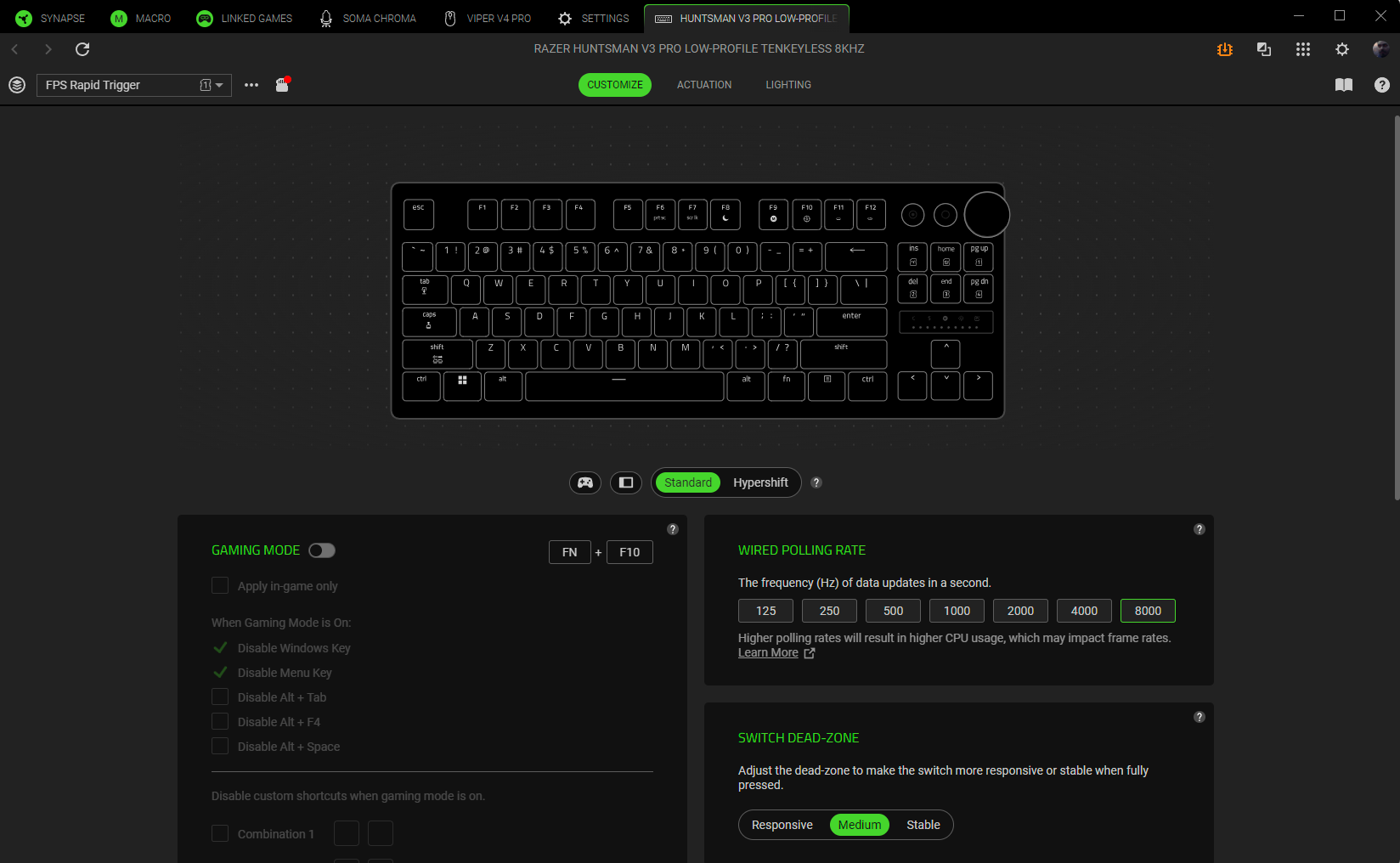
The Huntsman V3 Pro Low-profile allows actuation to be adjusted anywhere between 0.1 and 2.8 mm, giving me plenty of freedom to configure individual keys around what I’m doing. WASD can be extremely sensitive while abilities or other commands can require a deeper press, reducing accidental inputs. Adjustable actuation isn’t only useful for making everything faster; sometimes making a specific key more deliberate is equally valuable. Rapid Trigger is where everything comes together. Rather than forcing a switch to return to a fixed reset point before another input can register, Rapid Trigger responds dynamically to key movement with sensitivity reaching as low as 0.1 mm. Combined with only 2.8 mm of physical switch travel, repeated directional changes feel incredibly immediate because there simply isn’t much unnecessary movement underneath my fingers.
This is also one of the areas where I prefer the character of the Low-profile over the HE. The HE gives me more physical travel and a broader analog range, which can be advantageous for players who prefer a more traditional keyboard feel or extensively use depth-sensitive commands. The Low-profile instead seems designed around asking how little movement is actually necessary to accomplish an input. For competitive FPS gaming, I really enjoy that approach. Razer’s 8,000 Hz HyperPolling completes the performance package. Instead of communicating with the PC at the 1,000 Hz rate commonly associated with gaming keyboards, the Huntsman V3 Pro Low-profile can report up to 8,000 times per second. Razer rates its Low-profile Analog Optical implementation at an average 0.39 ms switch-to-USB latency under its testing conditions with actuation configured at 0.1 mm.
I’m not going to pretend I can reliably identify fractions of a millisecond while playing a game. Once keyboards become this fast, the display, game engine, system latency, and my own reaction time introduce much larger variables. What matters is that Razer has engineered the input pipeline to the point where the keyboard itself is extremely unlikely to become the limiting factor. Eight-thousand-hertz polling by itself isn’t going to transform the average player’s experience. Combined with 0.1 mm actuation, Rapid Trigger, optical positional sensing, and reduced physical travel, however, it becomes another part of an extremely aggressive performance package designed specifically for enthusiasts chasing every possible advantage.
Snap Tap, Snap Flex and Advanced Inputs
Snap Tap remains one of my favorite competitive features from Razer. When paired directional inputs overlap, Snap Tap can prioritize the intended input without requiring the previous key to be completely released first. During rapid left-to-right movement between A and D, it helps remove those small moments where imperfect finger movement can cause overlapping directional commands. The keyboard can also store up to four Snap Tap pairs onboard. Snap Flex expands what Razer can accomplish with analog sensing by allowing different actions through the behavior of a single key, including commands associated with pressing and releasing it. Dynamic Keystroke goes even further by allowing multiple commands across different stages of key travel, while Dual-Keypress Priority helps determine how simultaneous directional inputs behave.

Not everyone will use every one of these features, but that’s part of what separates an enthusiast keyboard from something designed for the broader gaming audience. There’s considerable depth here for players willing to experiment, and importantly, Razer doesn’t force me into Synapse every time I want to change something. Actuation and Rapid Trigger sensitivity can be adjusted through the keyboard’s digital dial and LED array, while Synapse and Synapse Web remain available for deeper configuration.
Premium Pricing for a Specific Player
There is no getting around the fact that the Huntsman V3 Pro Low-profile Tenkeyless 8KHz sits firmly in premium keyboard territory. This isn’t the keyboard I’d recommend to somebody who simply needs something good for gaming and everyday typing. There are considerably less expensive keyboards capable of doing those things extremely well, and the average player isn’t suddenly becoming competitive because their keyboard can report at 8,000 Hz or reset after 0.1 mm of movement.
The value proposition makes considerably more sense when looking at who Razer built this for. This is equipment for competitive gamers, professional-level players, and enthusiasts who care about polling rates, individual actuation distances, Rapid Trigger sensitivity, directional input behavior, and the technology determining where every key is throughout its travel. You’re paying for an incredibly specialized piece of hardware, and Razer isn’t really pretending otherwise. For the player who actually intends to take advantage of this technology, the combination of performance, build quality, customization, and thoughtful design helps justify that premium.
REVIEW SCORE: 10/10
The Razer Huntsman V3 Pro Low-profile Tenkeyless 8KHz earns the same 10/10 I gave the Huntsman V3 HE Magnetic, but the two keyboards earn that score for slightly different reasons. The HE remains an outstanding option for enthusiasts who specifically want magnetic switches, greater physical travel, and additional analog range. Nothing about this keyboard changes how highly I regard Razer’s HE implementation.

The Huntsman V3 Pro Low-profile appeals to me because Razer has taken its Analog Optical technology and built practically the entire keyboard around its strengths. I get 0.1–2.8 mm adjustable actuation, 0.1 mm Rapid Trigger sensitivity, 8,000 Hz HyperPolling, extensive advanced input controls, a 100-million-keystroke switch rating, and an exceptionally low 19.5 mm chassis. The build quality is excellent, but it’s the thoughtfulness behind how these technologies work together that impressed me most. Hall Effect may be the technology everyone is talking about right now, but newer doesn’t automatically mean better for every player. Optical positional sensing, shorter physical travel, excellent ergonomics, and extremely aggressive Rapid Trigger performance provide legitimate reasons why a professional player or enthusiast could deliberately choose this over its HE counterpart.
For more on Razer and gaming, follow my socials here – I also stream Mon-Sat @9pm ET over on Twitch, TikTok, and YouTube

