

OLED gaming monitors have reached a point where they no longer feel reserved for enthusiasts willing to spend a premium for cutting-edge technology. Better panel protection, improved text clarity, lower pricing, and stronger feature sets have made OLED a practical option for everyday gamers. Over the past few weeks, I have been using the ROG Strix OLED XG27AQDMG Gen 2 as my primary display for gaming, content creation, and general desktop use. ASUS has built a monitor that targets gamers looking to experience OLED without sacrificing functionality or spending flagship-level money.
The result is one of the strongest price-to-performance OLED gaming monitors I have tested.
Build Quality and Specifications
Build Quality and Specifications
The XG27AQDMG Gen 2 carries the familiar ROG aesthetic. The design is clean, modern, and practical. The stand occupies a surprisingly small footprint, leaving plenty of room on the desk for peripherals and accessories. ASUS also includes a threaded mount on the top of the monitor, allowing users to attach a camera, microphone, or light directly to the display.
The centerpiece is the 27-inch TrueBlack Glossy WOLED panel.
Specifications include:
- 2560 × 1440 resolution
- 240Hz refresh rate
- 0.03ms response time
- True 10-bit color
- 99% DCI-P3 color coverage
- G-SYNC Compatible certification
- AMD FreeSync Premium Pro support
- DisplayPort 1.4 DSC
- Dual HDMI 2.1 ports
- USB connectivity
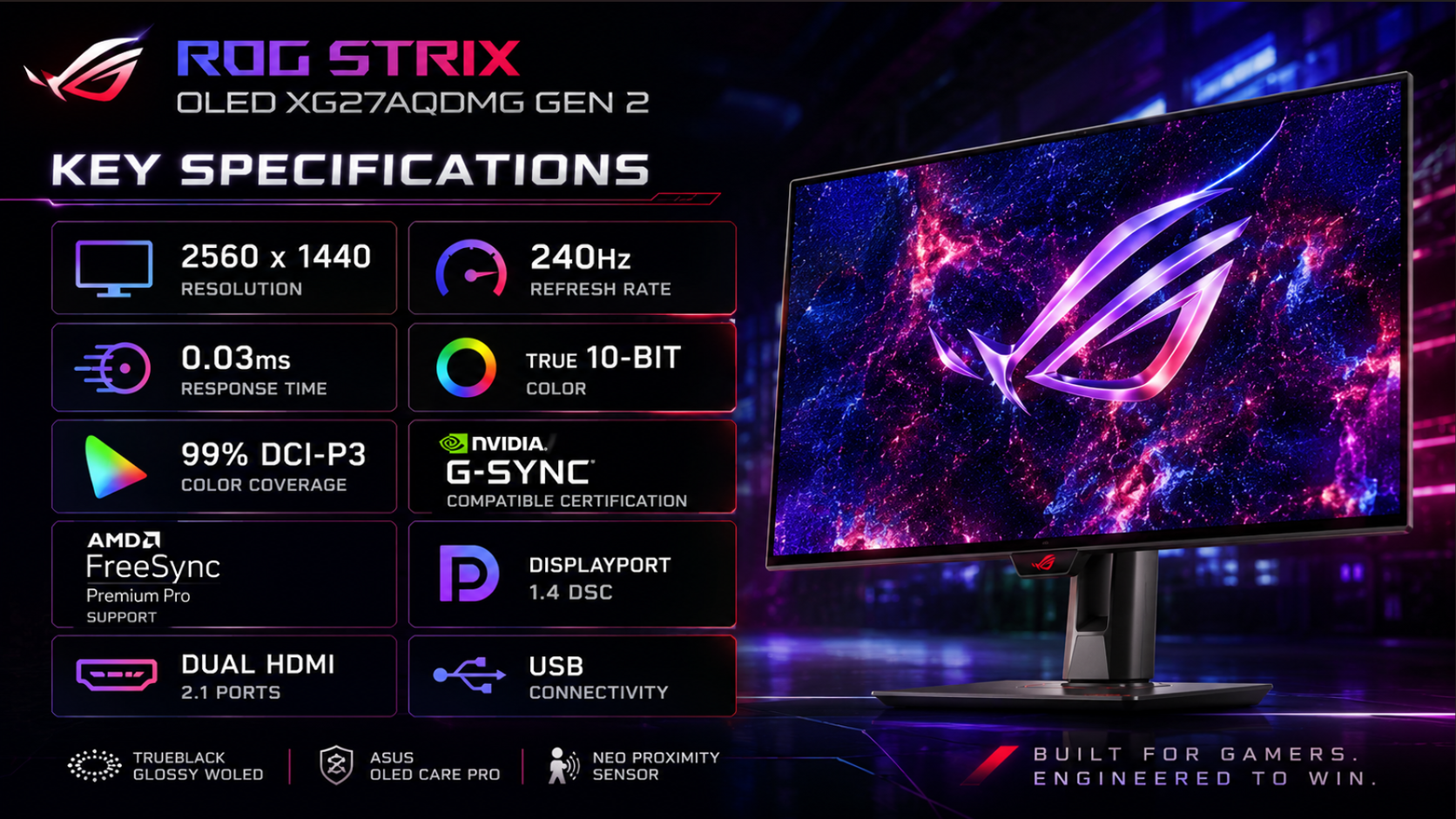
ASUS factory calibrates every ROG display before it leaves the factory, ensuring excellent color accuracy right out of the box. This remains one of the distinctions between the ROG and TUF Gaming families and is particularly valuable for creators and users who care about color consistency. Image quality is exceptional. Colors appear vibrant and accurate without looking oversaturated. Contrast is outstanding thanks to OLED’s ability to produce true blacks. HDR content benefits greatly from the panel’s dynamic range and impressive color reproduction.
One of the standout features of this display is ASUS’ TrueBlack Glossy coating. Unlike many WOLED gaming monitors that utilize matte finishes, ASUS employs a glossy coating and polarizer designed to improve image clarity while enhancing perceived black depth. After several weeks of use, the difference is noticeable. Games appear more vibrant, text looks crisp, and dark scenes carry greater depth. During my testing, the coating maintained excellent black levels even in brighter environments. Display technologies continue to evolve, and each approach carries its own strengths. Many QD-OLED panels utilize semi-gloss coatings and can exhibit a purple tint under certain lighting conditions due to the absence of a polarizer. During my time with the XG27AQDMG Gen 2, ASUS’ TrueBlack Glossy implementation delivered a consistently clean image with excellent contrast.
ASUS continues to offer one of the more polished software ecosystems available in the monitor market. DisplayWidget Center supports both Windows and macOS, allowing users to adjust monitor settings directly from the desktop rather than relying solely on the OSD. The software also integrates ASUS OLED Care Pro, making it easy to access panel protection features and manage long-term OLED maintenance. Features such as ASUS Uniform Brightness, aspect ratio controls, adjustable HDR tuning, and unclamped sRGB controls provide a level of flexibility that many competitors still struggle to match.
OLED Care Pro is equally impressive. ASUS provides a robust suite of panel protection features. The Neo Proximity Sensor remains one of the more useful additions I have encountered on an OLED display. When the user steps away from the desk, the display automatically transitions to a black screen to help reduce unnecessary panel wear. For anyone concerned about long-term OLED ownership, ASUS has clearly invested considerable effort into creating practical solutions.
Performance
I spent much of my testing playing Marathon, Diablo IV, and several other visually demanding titles. OLED’s near-instantaneous pixel response delivers exceptional motion clarity. Fast camera movement remains sharp. Competitive gameplay feels responsive. Input latency is effectively imperceptible. The 240Hz refresh rate provides a smooth and fluid gaming experience. Combined with G-SYNC Compatible and FreeSync Premium Pro support, gameplay remains free from noticeable tearing or stutter.
ASUS also addresses one of OLED’s historical weaknesses. The company’s Clear Pixel Edge technology significantly improves text rendering and desktop usability. Text appears sharper, UI elements look cleaner, and long work sessions feel far more comfortable than on many first-generation OLED displays. ASUS also includes Extreme Low Motion Blur (ELMB), also known as Black Frame Insertion. This feature can improve perceived motion clarity while operating at 120Hz, making it useful for console players or users whose systems may not always sustain high frame rates at 1440p with maximum image quality settings.
There are tradeoffs. Enabling ELMB disables VRR, reduces brightness, and introduces a slight increase in input processing. The added flexibility is appreciated and gives users another tool to tailor the experience to their hardware. The greatest strength of this monitor is balance. It delivers outstanding image quality, excellent responsiveness, robust OLED protection features, extensive customization options, and strong software integration. Few displays at this price point offer such a complete package.
My primary caveat comes down to personal preference. I have become accustomed to larger ultrawide displays over the years. A 34-inch version of this monitor would immediately become my preferred option. The 27-inch format remains excellent for competitive gaming and traditional desktop setups, but I personally enjoy the added immersion larger panels provide. The other consideration involves esports-focused players. While 240Hz remains extremely fast, dedicated competitors training for professional play may prefer 360Hz or 480Hz alternatives. Those displays cater to a very specific audience and represent a small segment of the gaming market.
Most gamers are playing to improve, stream, create content, and enjoy their favorite titles at a high level. For those users, 240Hz remains an excellent balance between responsiveness and visual quality.
REVIEW SCORE: 9.5/10
The ROG Strix OLED XG27AQDMG Gen 2 delivers premium OLED image quality, excellent gaming performance, industry-leading OLED protection features, and one of the strongest value propositions currently available in the OLED monitor market. ASUS has successfully addressed many of the concerns that once kept gamers away from OLED displays. Better text clarity, advanced panel protection, excellent software support, and thoughtful quality-of-life features help elevate the overall ownership experience.
After several weeks of daily use, I believe ASUS has created one of the most compelling entry points into OLED gaming available today. The XG27AQDMG Gen 2 combines visual fidelity, responsiveness, functionality, and value into a package that is easy to recommend.
For more on ROG and gaming, follow my socials here – I also stream Mon-Sat @9pm ET over on Twitch, TikTok, and YouTube

