

If you caught our outdoor gear coverage last year, you know I’m no stranger to Mammotion. Last season, we spent some quality time reviewing the compact Luba Mini AWD. To its credit, that little machine did an impressive job keeping the grass tight, proving that Mammotion’s signature All-Wheel Drive DNA scales down beautifully. We did have to physically install a traditional RTK antenna in the yard to keep it oriented, which wasn’t a major pain by any means, but it was a necessary step to get that signature precision.
But as properties scale up, so do the challenges. A sprawling piece of land with diverse terrain requires a completely different class of machine.
Enter the Mammotion Luba 3 AWD 3000H.
This is a standalone, focused look at a significantly larger hardware platform designed to conquer the type of real-world obstacles that leave smaller robot mowers spinning their wheels. Mammotion has already cemented its reputation for brute force, but the Luba 3 generation introduces some serious intelligence upgrades to match that muscle—starting with the fact that it can completely bypass the physical antenna setup. Let’s see how it earned its keep on our turf.
Breaking Down the Luba 3 Series
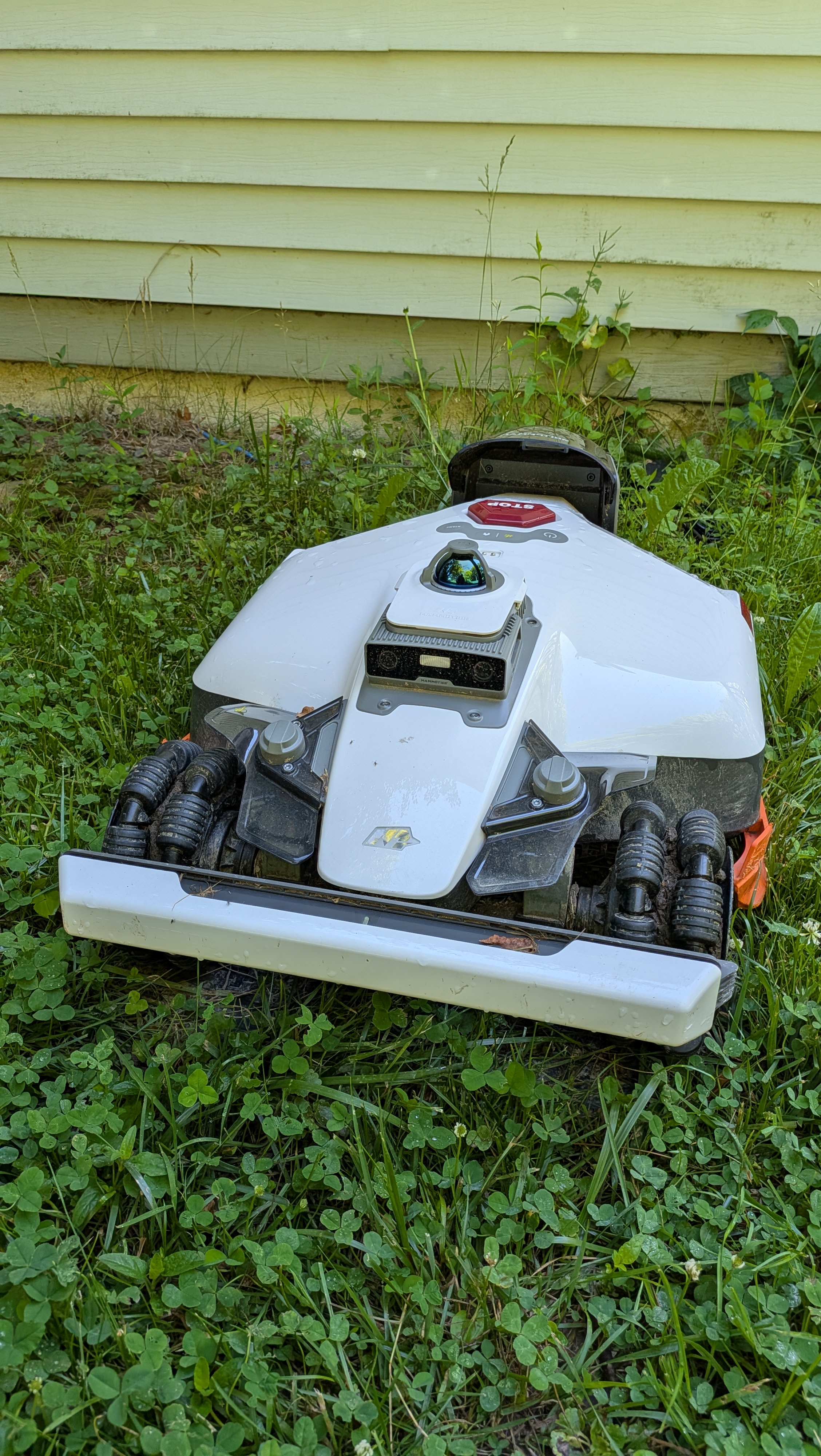
Before diving into the performance, it helps to understand how Mammotion is laying out this generation. The Luba 3 line is structured as a series tiered by cutting height and total acreage capacity:
- Luba 3 AWD 1500 / 1500H: Built for properties up to 0.37 acres.
- Luba 3 AWD 3000 / 3000H: The mid-tier sweet spot handling up to 0.75 acres.
- Luba 3 AWD 5000 / 5000H: The heavy hitter maxing out at 1.25 acres.
What does the “H” mean? If you see an “H” attached to the model name, you are looking at the High-Cut version. While the standard version cuts from 1.0 to 2.7 inches, the H models feature a taller, beefier deck range of 2.2 to 4.0 inches along with extra ground clearance.
For our review, we’ve been running the Luba 3 AWD 3000H, which sits at a retail price of $2,799 (available on Amazon).
What I Loved: True Setup Simplicity and Live Sight
The absolute headline win for the Luba 3 is the integration of iNavi NetRTK. Remember how we had to mount a physical GPS base station antenna on a pole for the Luba Mini AWD? Mammotion has evolved the tech to the point where that is entirely optional now. Instead of communicating with a physical beacon on your property, the Luba 3 pulls its correction data seamlessly over the cellular 4G network or your home Wi-Fi.
Setup was an absolute breeze because of this. I literally just walked the machine around my boundary lines using the app to map the zones, and it was ready to work right out of the gate.

Once it’s running, Mammotion’s “Tri-Fusion” system—which blends that NetRTK with a 360-degree LiDAR dome and dual-camera AI vision—does a phenomenal job. It finishes its daily cycles with incredibly minimal intervention from me. It simply doesn’t get lost under heavy tree canopies or throw a tantrum near high retaining walls.

Another legacy feature I still absolutely love is the ability to pull up a live video view from the onboard cameras inside the app. If the machine ever wanders into a far corner of the property out of direct sight, I don’t have to guess where it went. I just pop open the feed, see exactly what the robot is looking at, and find it instantly.
Bumps Along the Way: The “Getting to Know You” Phase
It wasn’t all perfectly smooth sailing, though. During our initial testing phase, I noticed a couple of distinct quirks.

First, despite having rugged AWD capability, the Luba 3 kept getting tripped up by a thick cable running flat across the path between my front and back yards. It would hit that cable and stop dead, claiming a block. The funny part? If I walked out and manually nudged it, or simply pressed “Resume” in the app, it would roll right over the obstacle with total ease. The hardware has the clearance and the torque to clear it easily, but the software was playing it a bit too cautious.
Second, the bot likes to cry wolf. I’d occasionally get an alert on my phone stating the mower was hopelessly stuck and needed manual assistance. I’d walk outside to rescue it, only to find the Luba 3 already driving along happily, having successfully pulled itself out of whatever minor rut or ditch it was complaining about a minute prior.
This brings me to the one feature I desperately wish Mammotion would include: true remote manual driving.

Right now, you can control the mower like an RC car, but only if you are standing right next to it over a local Bluetooth connection. I understand the safety precautions surrounding spinning cutting blades, but it would be incredibly handy to control just the wheels completely remotely over the cellular network. When the app falsely claims it’s stuck, it would be amazing to pull up that live camera feed from my office desk, take the virtual joysticks, and back it out of a tight spot yourself without having to put boots on the ground.
Specs at a Glance
- Retail Price: $2,799
- Navigation: Tri-Fusion (360° LiDAR + NetRTK + Dual-Camera AI)
- Cutting Height: 2.2″ – 4.0″ (Electronic Adjustment)
- Mowing Time: Up to 175 minutes per charge (12Ah Battery)
- Connectivity: Built-in 4G (Includes 3 years of free data/iNavi service), Wi-Fi, Bluetooth
- Durability: IP55 water and dust resistance, integrated rain sensor
Do I Recommend The Luba 3 AWD?
The Mammotion Luba 3 AWD 3000H is a fantastic, premium addition to the brand’s lineup and further cements my appreciation for what they are doing in the automation space. It cuts beautifully, handles raw terrain like an off-road buggy, and dropping the requirement for a physical yard antenna entirely makes rapid deployment a reality.

Honestly, the only missing piece in the puzzle for Mammotion right now is scale. While the Luba 3 line is highly capable, the brand currently lacks a massive residential model that can comfortably cover 2.0 to 2.5 acres on a single unit. If they eventually add a mega-capacity variant for those larger estates, it will become an effortless recommendation across almost every single yard size out there. Until then, if you’ve got up to an acre of challenging turf, this is the machine to beat.

