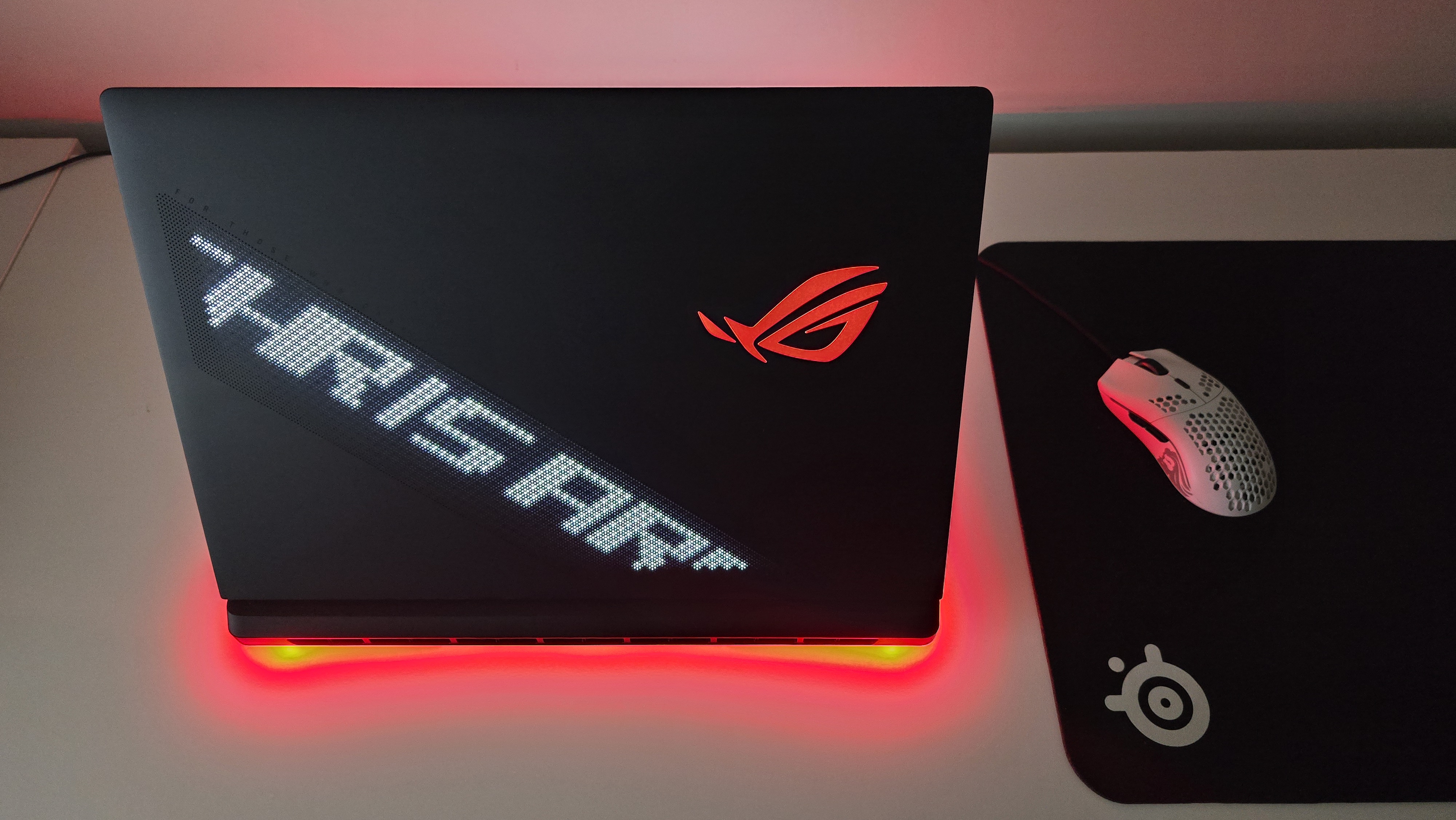

It’s been over a month since ROG sent me their latest ROG Strix Scar 18 and G18—I say this with complete confidence: ASUS is operating at a different level in 2025. The focus on delivering smart ways to play while leveraging state-of-the-art components is true here. It’s designed for those who desire performance and eliminates the need to dive deep into specs. I reviewed the SCAR 18 2024 last year, and I was curious to see how much further ASUS could push the formula. Turns out, they didn’t just tweak around the edges. They refined the entire experience.
An Engineering Masterclass
Both the Scar 18 and G18 follow similar designs: 18-inch 16:10 displays, robust cooling systems, customizable RGB lighting, and an ROG design that’s both familiar yet thematically minimalist – but the G18 has a different tonal look that utilizes last year’s TUF series militaristic design. The SCAR 18 is the flagship, of course, everything about it feels maxed out—from its customizable Mini LED AniMe display strip on the front to the performance ceiling that can go up to an Intel Core Ultra 9 and NVIDIA’s RTX 5090 GPU. The G18, on the other hand, shares much of the same structure and build quality, but with a more streamlined approach. It’s slightly more reserved in both design and configuration, focusing on delivering high-end power that’s a bit more accessible—and just as purposeful. This model adopts the TUF lineup’s overall aesthetics, everything is much simpler in design, and the key difference between the two models is that the WASD and Spacebar are transparent with LED functions. Both models come with LED strips underneath the laptop, and both have an easy-to-access to access hatch beneath the laptop to allow for toolless upgrading of their RAM and Gen 4 M.2 SSDs.
Coming from the 2024 SCAR 18, the first thing that caught my attention was the screen. Last year’s panel was already strong, with crisp visuals and fast refresh rates. But the jump to a Nebula HDR Mini LED panel in the 2025 SCAR 18 is one of those upgrades you see instantly. The brightness alone is striking, peaking at 1200 nits, and it delivers serious punch for HDR content. The screen has an additional layer of film to help reduce reflections (and it sure does help), making the blacks appear deeper and much closer to OLED displays. Highlights are sharper, and everything just feels more lifelike. The G18’s display isn’t HDR compatible and only goes up to 500 nits, yet still impresses with its 2.5K 240Hz Nebula panel. It’s vibrant, color-accurate, and more than enough for gaming or content creation. For many users, especially those focused more on frame rate than color depth, it hits that sweet spot.

Use case perspective:
- If you’re into cinematic visuals, do photo/video work, or just want your screen to feel like a mini home theater, the SCAR 18’s HDR display is worth the upgrade.
- If your focus is on gameplay, multitasking, or general productivity, the G18’s display more than holds its own.
- The SCAR 18 is ideal for power users, creatives, and gamers who want the absolute best portable experience available—no compromises.
- The G18 is for gamers and professionals who want premium performance without jumping into the flagship tier. It’s still fast. Still premium. Just more measured.
The SCAR 18 2025 delivers top-tier power, now driven by Intel’s Core Ultra 9 275HX and up to an RTX 5090. The Ultra 9 series has proven to hold up when developing games, for example, which in turn would help with 4K editing, 3D rendering, and demanding workloads. Serious state-of-the-art components that are matched with genius-level engineering when it comes to cooling – more on that shortly. The G18 can do much of the same as the Scar 18; however, it is limited to the RTX5080, which can be more than enough for gamers, but anyone looking to push accuracy and workloads would probably want to stick with the Scar 18 model.
What’s New vs 2024?
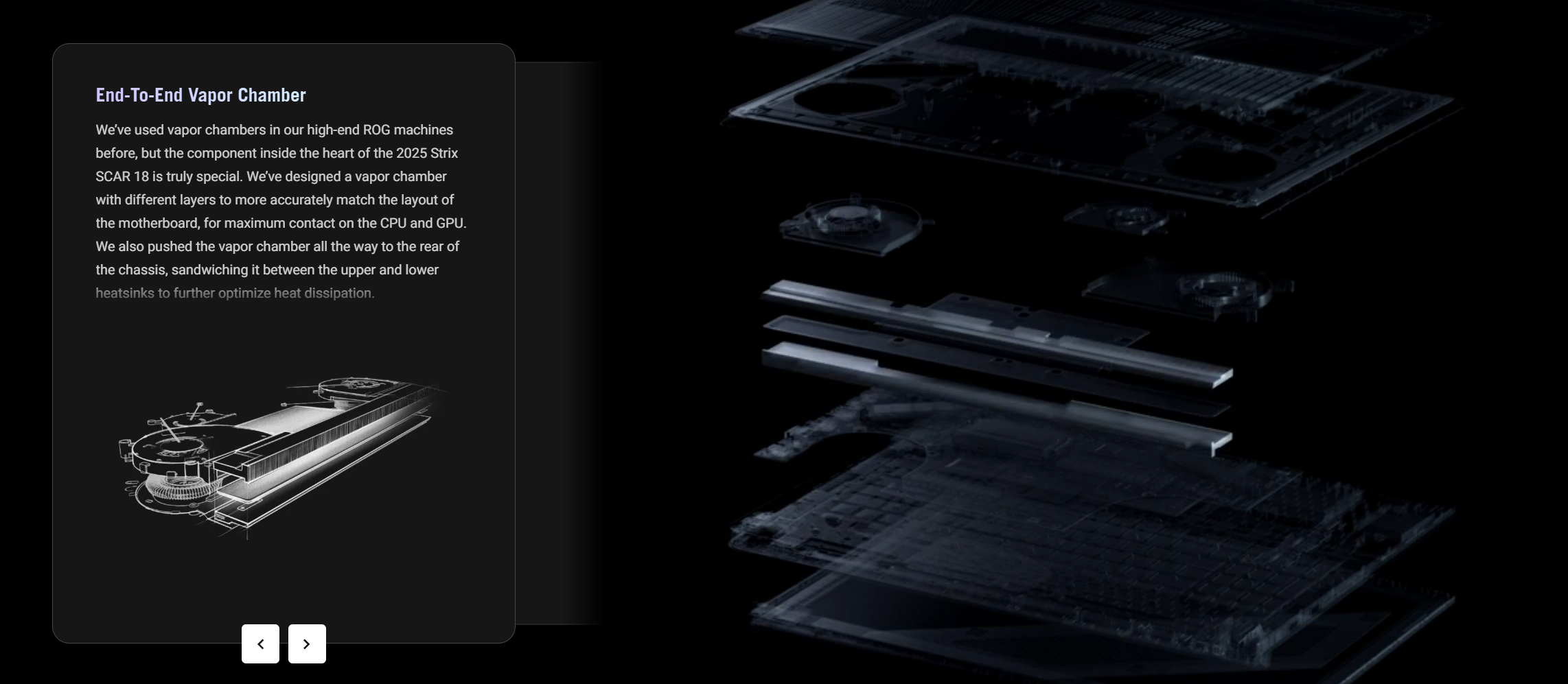
I reviewed the 2024 model last year and gave it overwhelming praise for its powerhouse and excellent engineering. It’s easy to see the price gap and assume you’re just paying for flash, but the reality is, the SCAR 18 earns its premium. Now, the biggest problem to solve in gaming laptops is the cooling. There are all types of cooling pads to buy, but what’s genius about this laptop is the end-to-end vapor chamber solution; it has 3 fans, which ROG is calling Tri-Fan, that support these heatsinks that are sandwiched together, which can help cool the laptop up to 15°C when idle. I’ve ramped this machine up to its potential for my entire duration, and during peak gaming, I didn’t see it go beyond 67°C. I love this solution as it solves a lot of inherent issues when it comes to gaming on the go, and truth be told, based on my testing, it’s highly effective. This is coupled with what I think is the first gaming laptop to have liquid metal cooling its chipsets – coined Conductonaut. This is a highly effective solution, though still new in the computer world, and only time will tell if it’ll cause leakage or other problems.
This laptop comes with several great elements, which includes MUX Switching between its iGPU and dGPU, several IO inputs such as Ethernet, HDMI 2.1, 3x USB 3.0, 2 USB-C and an amazing sound system that’ll blow any competition out of the water – seriously insane stuff, though primarily effective during low power entertainment as fan noise is still prominent when gaming on peak hours; noise can reach up to -50db if pushed to its limits, but that to me is still relatively quiet during those conditions. Comes with Noise Cancellation alongside Dolby ATMOS, which further emboldens its sound properties.
My biggest grip with this computer however is the fact that ROG are still having issues with their MUX switch; much like last year’s model, most games can handle the switch between in-game and other software, but newer games tend to mess with the display mid-session; for example, when reviewing Dune: Awakening even with the latest drivers (and reverting), my display would black-out with sound still running. Then the game would either crash or stall, which would force a restart. This is highly irritating as I still haven’t found a solution to this problem. I often just result in turning off the MUX in Amory Crate and keep on pushing. Another caveat is that the RTX50 series no longer supports PhysX, which could render a slew of older games obsolete at some point. That is something to consider upgrading if you still play games that were released in the early 2000s. Oh, and I hope you don’t suffer greasy hands, this thing is a fingerprint magnet. Make sure to have a micro-fiber cloth with you if you play MnK.

Temps and Gains
I’ve played several games on this machine, here’s some of my analysis regarding FPS and Temps:
| Game | Avg FPS | 1% Lows | Frame Spikes | Avg Temps |
|---|---|---|---|---|
| Destiny 2 | 144 | 111 | Stable | 68° C |
| Cyberpunk 2077 | 122 | 88 | ~3-5ms | 67° C |
| Dune: Awakening | 98 | 71 | ~7ms | 64° C |
| Doom: The Dark Ages | 170 | 135 | ~2ms | 72° C |
| SplitGate 2 | 158 | 124 | Stable | 75° C |
- Average FPS & 1% Lows: Real-world fluidity and responsiveness
- Frame Time Stability: For micro-stutters or dips that might impact playability
- Thermal Behavior: CPU/GPU temps under sustained load to evaluate cooling efficiency
REVIEW SCORE: 9/10
ASUS continues to evolve the Strix lineup thoughtfully. The SCAR 18 2025 feels like a mature version of an already strong platform—more polished, more responsive, and visually stunning. The G18 is a refined option that trims just enough to meet the needs of most users without ever feeling stripped down. The MUX switch can occasionally freeze during transitions. Otherwise, this is as close to desktop-class power and polish as you can get in a laptop today.
For more on ROG Strix and gaming, follow my socials here – I also stream Mon | Tues | Thurs | Fri @10pm ET over on Twitch, Kick, TikTok, and YouTube

