
Recently, I’ve been locked in a battle with rising utility costs over the last couple of years (the battle may be one-sided, as I’m sure they aren’t thinking about me!). Between electric companies constantly hiking rates and delivery charges from Central Hudson (my utility provider) getting out of control, keeping household energy expenses reasonable has become an uphill fight.
Even though I have solar panels on the roof and geothermal handling my heating and cooling, transitioning away from oil and gas meant consolidating almost all our household energy into electricity. On paper, electricity is cleaner and typically cheaper, but when your utility starts tacking on massive delivery fees, every kilowatt-hour hurts.
I’m a data guy at heart. Before making any drastic moves, I spent months pulling baseline reports from 2023 through 2026—auditing my Sense energy monitor data, historical solar production, and utility bills to see exactly where energy was leaking. While I have a whole-home Tesla Powerwall 3 on the way to help buffer peak hours, municipal permitting and red tape take time.
That brought me to an intriguing new hardware platform: the Pila Energy Mesh Home Battery.
What Is the Pila Mesh Home Battery?
The easiest way to understand Pila is to think of it as a modular, localized microgrid. While massive units like the Tesla Powerwall are hardwired directly into your main electrical panel to back up an entire house, Pila takes a completely plug-and-play approach.

It’s a compact home battery that plugs into a standard 120V wall outlet. From there, you plug your critical equipment directly into the Pila unit. Instead of waiting months for town building permits, utility interconnection approvals, and an electrician tearing up your drywall, Pila gives you localized power backup and automated time-of-use management right out of the box.
Each unit retails for $1,499. While that’s not pocket change, it costs a fraction of a hardwired whole-home battery system and requires zero installation fees.
Setup: True Plug-and-Play Simplicity

Unboxing and getting Pila online was seamless. The hardware itself has some serious heft to it (definitely keep that in mind if you plan on lifting it onto a shelf or above an appliance), but the industrial design is clean and modern.
Mounting versatility is one of its strongest design elements:
- Lay it flat: Clean horizontal footprint under a desk or console.
- Vertical stand: Lets you stand it upright next to your workstation or appliance.
- Wall-mount kit: Keeps it elevated completely off the floor if floor space is tight.


Once you pick your spot, setup takes about two minutes: plug the included power cable into the wall, connect it to the back of the Pila, and flip the power switch. You download the Pila companion app, set up an account, name the device, and assign it to its room.
The standout engineering feature is the Pila Mesh Network. When I spun up my second unit, I didn’t have to configure settings, schedules, or energy profiles from scratch. The first unit automatically synchronized its profile across the mesh. Even better, because the units communicate over their own local mesh network, they don’t depend on active Wi-Fi to coordinate during a power outage.
How I’m Using It: Two Targeted Zones
To tackle peak electric rates, I deployed two Pila units in high-priority microgrid zones:
- The Home Office: Powers my Mac mini, 38-inch ultrawide monitor, desktop peripherals, room TV, mesh Wi-Fi access point, and a wine cooler.
- The Kitchen: Dedicated strictly to backing up our primary refrigerator and a small kitchen PC.


Central Hudson’s on-peak billing window runs weekdays from 2:00 PM to 7:00 PM. The goal isn’t just surviving a blackout; it’s peak-shaving. The Pila units recharge off-peak when rates are low (or when solar generation is high). Then, precisely at 2:00 PM, they switch over to internal battery mode to power my office and kitchen appliances completely disconnected from the grid.
I have my units configured to run on battery power straight through the 2:00 PM to 7:00 PM peak window and well into the late evening (around 11:45 PM), down to a 20% reserve floor. Once midnight hits, smart switches shut down lingering vampire loads while the Pila quietly charges overnight on the cheapest off-peak electricity.
When my Powerwall 3 is fully operational, having these dedicated microgrids means the Powerwall doesn’t have to carry the office desk or the fridge during peak hours, stretching whole-home backup endurance even further.
What I Like
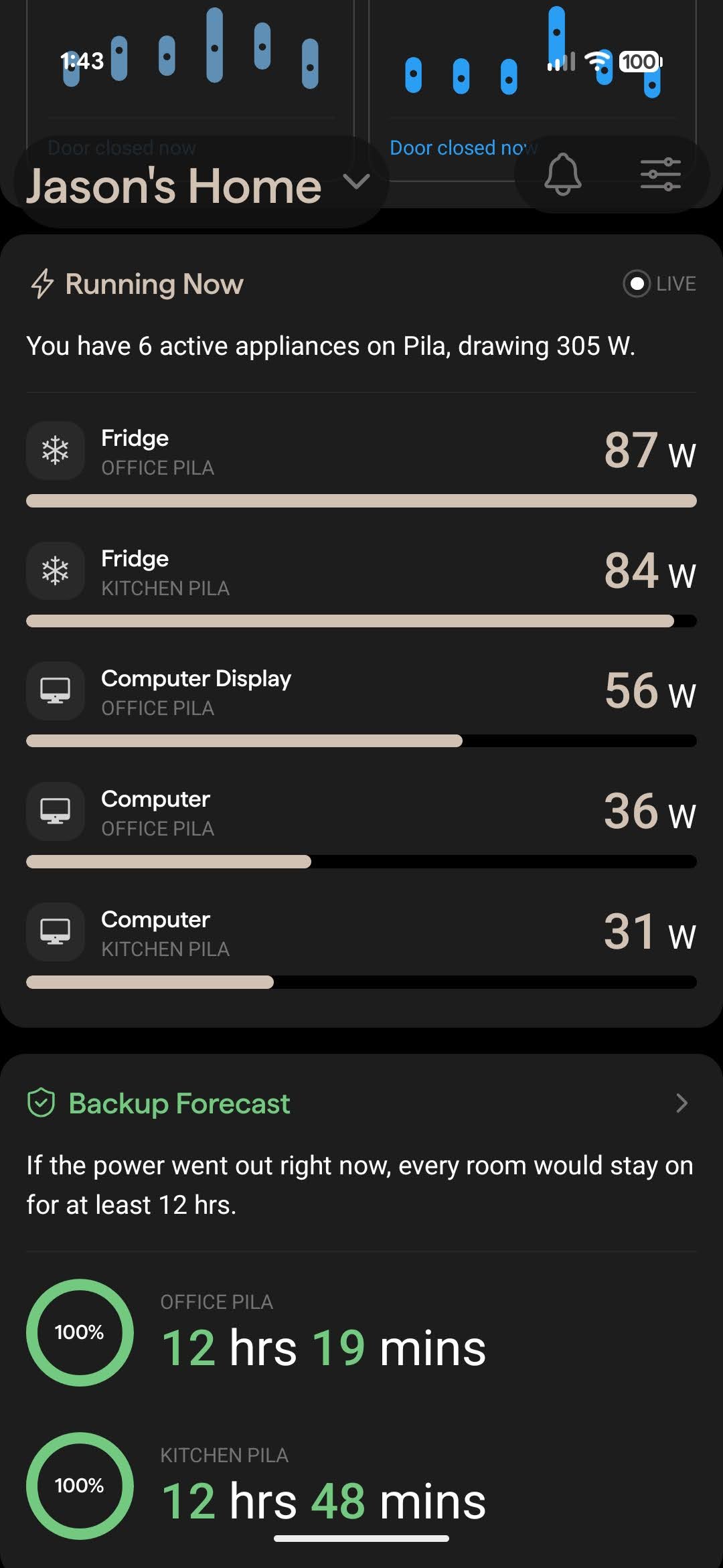
- Instant Outage Protection: In the event of a blackout, the app provides real-time runtime forecasts. Currently, my office setup shows around 14 hours of continuous backup, while the kitchen fridge unit provides about 11 to 12 hours of runtime.
- Fridge Temperature Monitoring: Pila offers dedicated wireless temperature sensors. I have one in the fridge and one in the freezer. If internal temps creep outside safe zones during an outage, the app alerts me instantly.
- Clear Data & Tracking: The app layout is polished and straightforward. Over the last 24 hours alone, 94% of the energy consumed across my Pila outlets came from off-peak or stored battery power, exactly delivering on my cost-reduction goal.
- Simulated Outage Readiness: With my Powerwall installation requiring utility power to be shut off for 6 to 8 hours, the office Pila unit will let me keep working on the computer without missing a beat.
Where It Needs Improvement: The Solar Gap
My primary critique isn’t a flaw in build quality; it comes down to third-party solar integration.

The Pila app includes an Optimize Solar Usage mode designed to charge the batteries strictly when your solar array is actively generating. However, without a direct hardware link to your inverter, Pila estimates solar output based on system size and zip-code weather forecasts. In the real world, cloudy days or passing storms throw those estimates off, occasionally causing the battery to pull grid power during peak hours when it mistakenly assumes the sun is out.
Pila does offer direct solar pairing in beta, but it currently only integrates with Enphase solar systems. Because my home setup runs on a SolarEdge inverter, direct inverter communication isn’t supported yet. I spoke directly with Pila’s CEO at an event in Brooklyn, and he confirmed they are actively working to expand inverter compatibility down the road. But for now, SolarEdge owners will have to wait for tighter real-time telemetry.
Who Is Pila For?
While I’m using Pila to augment an existing solar setup and an incoming whole-home battery, its most compelling use case might actually be for renters and apartment dwellers.
If you rent or live in a multi-unit building, you cannot drill into an exterior wall to install a Tesla Powerwall or mount permanent roof panels. Pila bypasses that entirely. As balcony solar legislation and plug-in solar kits continue to gain legal traction across states like New York, pairing a plug-in solar panel with a Pila battery gives apartment dwellers a safe, fully portable microgrid. You can keep your food cold and your devices charged during a ConEd outage without needing a landlord’s permission.
Wrap Up
The Pila Energy Mesh Home Battery delivers an intelligent, elegant alternative to the traditional all-or-nothing approach to energy storage. Whether you’re looking to dodge peak utility rates, protect your office setup during blackouts, or build a renter-friendly emergency power reserve, Pila makes deployment dead simple.
Expanding direct solar pairing beyond Enphase will be crucial for power users with diverse inverter setups, but as a standalone, modular microgrid, it has earned a permanent spot in my home energy layout.
Have you heard of Pila Energy? Have you been looking to find ways to save on rising energy costs? Let us know in the comments if this is something you would be interested in adding to your household.

