

I came to PC gaming from a controller, and that background still influences what I want from my peripherals. Having more control over my inputs was appealing, but moving away from a thumbstick meant relearning something that already felt natural. Years ago, that transition led me to the Razer Orbweaver Chroma. The idea of a dedicated keypad with controls clustered around one hand immediately caught my attention. I wanted something that could bridge that gap, but the Orbweaver never quite lived up to my expectations.
The Razer Tartarus V2 Pro brought that interest back. A full-sized thumbstick alongside programmable optical keys is exactly the kind of combination that appeals to the controller gamer in me. After spending about a week with it, including time in Marvel Rivals and Marathon, this model finally delivers on the experience I had hoped to find years ago. There are still a couple of things I would change, particularly around comfort and physical customization, but the foundation makes considerably more sense for how I want to play.

Build Quality and Design
The Tartarus V2 Pro brings together a bank of textured doubleshot PBT keycaps, a side-mounted TMR analog thumbstick, and an adjustable wrist rest. Visually, it carries the familiar Razer identity, with a black finish and per-key Chroma RGB lighting. The layout gives the thumbstick a substantial role in the design, which matters when you intend to use it for movement instead of treating it as an extra set of shortcuts. Razer has also put attention into the key assembly. The Gen-2 analog optical switches use box-style stems and stabilizing wires, while plate and bottom foam provide internal sound dampening. Pre-lubed stabilizers round out the package. These are meaningful construction details for something built around repeated inputs, although a week of use only tells part of the durability story. The same applies to the TMR thumbstick: its contactless magnetic sensing reduces wear within the sensing mechanism, but long-term reliability is something that takes longer to establish of course.
The wrist rest offers both sliding and tilt adjustments through two side buttons, giving you room to change how your hand sits relative to the controls. I appreciate having that flexibility, but I still experienced some fatigue even with the adjustments available. My other wish is more physical customization for the keyboard caps, particularly QWERTY legends that correspond to familiar keyboard assignments. Numbered caps accommodate different mappings, but seeing the actual letters would make the relationship between an on-screen prompt and the keypad more immediate. Razer does include two additional thumbstick caps of different heights, which is useful, but I would like that personalization to extend further across the keys themselves.
Specifications

- Switches: Razer Analog Optical Switches Gen-2.
- Adjustable actuation: 0.1–4.0 mm, with Rapid Trigger support.
- Programmable controls: 31, configurable through Razer Synapse.
- Thumbstick: Full-sized TMR analog stick with True Analog, four-way, and eight-way modes.
- Thumbstick customization: Two additional interchangeable caps of different heights.
- Keycaps: Textured doubleshot PBT.
- Wrist rest: Adjustable reach and tilt.
- Polling rate: Up to 8,000 Hz over a wired connection.
- Onboard storage: Three profiles with eight keymaps each, totaling 24 keymaps.
- Lighting: Per-key Razer Chroma RGB.
- Internal dampening: Plate foam and bottom plate foam, with pre-lubed stabilizers.
- Additional input features: Razer HyperShift, Snap Tap, Snap Flex, Dynamic Keystroke, and Dual-Keypress Priority.
- Listed US price: $199.99.
Performance Grade
Marvel Rivals and Marathon were where I spent time putting the hybrid format to use, with the thumbstick handling movement in both games. That is the central appeal for me. Moving with my thumb preserves a familiar part of playing on a controller, while the surrounding keys provide the flexibility that drew me toward PC peripherals in the first place. It gives me a way to carry that familiarity into a different control layout.

In Marvel Rivals, the appeal is having movement under my thumb while keeping the key bank available for the rest of a character’s commands. That separation is especially relevant in a game where movement and ability inputs compete for your attention. There is still a layout to learn, but this is the kind of arrangement that enticed me when I originally picked up the Orbweaver Chroma. The Tartarus V2 Pro makes that idea worth revisiting, with enough programmable controls to shape the setup around your preferences. Marathon gave me another setting to use that same approach. Taking thumbstick movement into a different game reinforced why I wanted this format to work in the first place. The value is in being able to build around a familiar movement input while adapting the surrounding commands to the game. Having separate keymaps available supports that approach, and the onboard profiles give the hardware somewhere to retain those configurations.
There is an important distinction between using the stick for movement and how a game interprets that input. Razer offers True Analog alongside directional modes, so the appropriate configuration depends on the game and its input support. The presence of an analog stick alone does not guarantee identical controller behavior everywhere. That flexibility is useful, though, because it gives the keypad more than one way to fit into a setup.
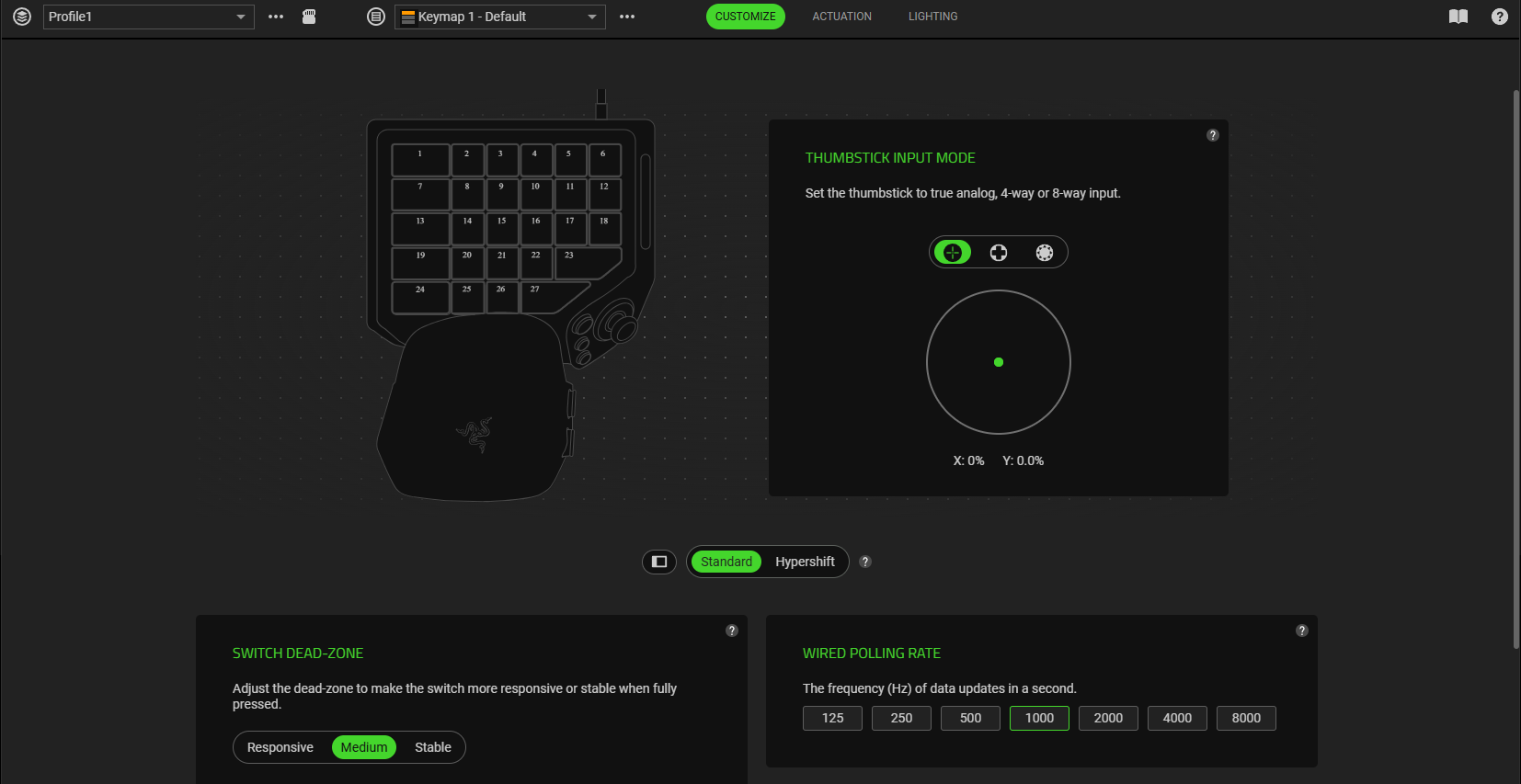
The optical keys add another level of adjustment. You can set how far a key needs to travel before registering, and Rapid Trigger lets it reset based on upward movement instead of requiring a return to a fixed reset point. Those settings apply to the keys, independently of the thumbstick. Likewise, the advertised 8,000 Hz polling rate is a reporting specification; it does not establish how much better anyone will play. What makes the Tartarus compelling to me is the control arrangement and how extensively it can be tailored.
REVIEW SCORE: 9/10
The Razer Tartarus V2 Pro delivers on an idea that has interested me since my transition from controller to PC. My experience with the Orbweaver Chroma left that interest unresolved, but this model gives me a hybrid format I can recommend after a week of use. Using the thumbstick for movement in Marvel Rivals and Marathon put the feature that mattered most to me at the center of the experience.
At $199.99, this is a deliberate purchase for players who know they want a dedicated keypad. I highly recommend it to competitive players who are drawn to this combination of thumbstick movement and programmable keys. The remaining fatigue keeps the adjustable wrist rest from completely solving comfort for me, and I would still like more physical keycap customization with familiar QWERTY labeling. Those are the areas I want Razer to refine. As it stands, the Tartarus V2 Pro finally gives me a reason to embrace the format that caught my attention years ago.
For more on RAZER and gaming, follow my socials here – I also stream Mon-Sat @9pm ET over on Twitch, TikTok, and YouTube

