

The Samsung 990 PRO was already quick enough to satisfy most gamers and creators, but the rise of AI workloads and ballooning file sizes demanded something beyond incremental speed bumps. Samsung’s answer is the 9100 PRO 8TB, its first consumer PCIe 5.0 SSD. After putting it through real-world tests, it feels less like an upgrade and more like the line in the sand for what future storage should deliver.
Design and Build
The 9100 PRO keeps a subtle look, but its design choices are intentional. The 8TB heatsink model measures just 11.25mm, slim enough for desktops and even Sony’s PlayStation 5. Instead of going overboard with oversized fins, Samsung focused on efficiency. The heatsink meets PCI-SIG D8 standards and does its job quietly. In extended stress, the drive never touched thermal throttling, a problem that plagues less refined solutions. Consistency matters more than flash, and the 9100 PRO nails that balance.
Samsung didn’t hold back with performance. Sequential read speeds peak at 14,800 MB/s, while writes top out at 13,400 MB/s, nearly doubling the 990 PRO. Random performance isn’t far behind with 2,200K IOPS reads and 2,600K IOPS writes, making it responsive even in workloads heavy on smaller data transfers. In day-to-day use, installs that once felt like waiting rooms finish before you can look away. 8K project files scrub smoothly in editing timelines, and AI checkpoints load in half the time compared to PCIe 4.0 drives. This is the kind of performance that doesn’t just measure well—it changes habits.

Specs Overview
| Feature | Samsung 9100 PRO 8TB |
|---|---|
| Interface | PCIe® 5.0 NVMe |
| NAND | 8th Gen V-NAND, 3-bit MLC |
| Controller | Samsung “Presto” 5nm |
| Capacity Options | 1TB, 2TB, 4TB, 8TB |
| Sequential Read | Up to 14,800 MB/s |
| Sequential Write | Up to 13,400 MB/s |
| Random Read | Up to 2,200K IOPS |
| Random Write | Up to 2,600K IOPS |
| Power Efficiency | 49% higher vs 990 PRO |
| Power Consumption | 9W read / 8.2W write (8TB) |
| Heatsink Thickness | 11.25mm (PS5 compatible) |
Built for the AI Era
Storage constraints feel outdated here. With 8TB, my Steam library sits alongside raw video projects and AI model checkpoints without compromise. Large game installs—150GB for Assassin’s Creed Shadows, 130GB for Black Myth Wukong—barely register against the total pool. Even looming giants like GTA VI, rumored at over 700GB, lose their intimidation factor. More than convenience, it changes workflows. Entire creative projects remain on one drive, eliminating shuffling between externals. AI researchers and tinkerers can keep multiple models local. The 9100 PRO turns storage from something you manage into something that simply works.
Samsung designed this drive with on-device AI in mind. Copilot+ PCs, Stable Diffusion, and GPT models all thrive on fast sequential reads and generous capacity. The 9100 PRO delivers both. Stable Diffusion checkpoints, often several gigabytes each, load instantly. Microsoft’s Recall, which archives months of snapshots for quick retrieval, can stretch into terabytes—this SSD swallows it effortlessly. AI is no longer just about CPU or GPU; storage is now a key player, and Samsung seems to understand that better than most.
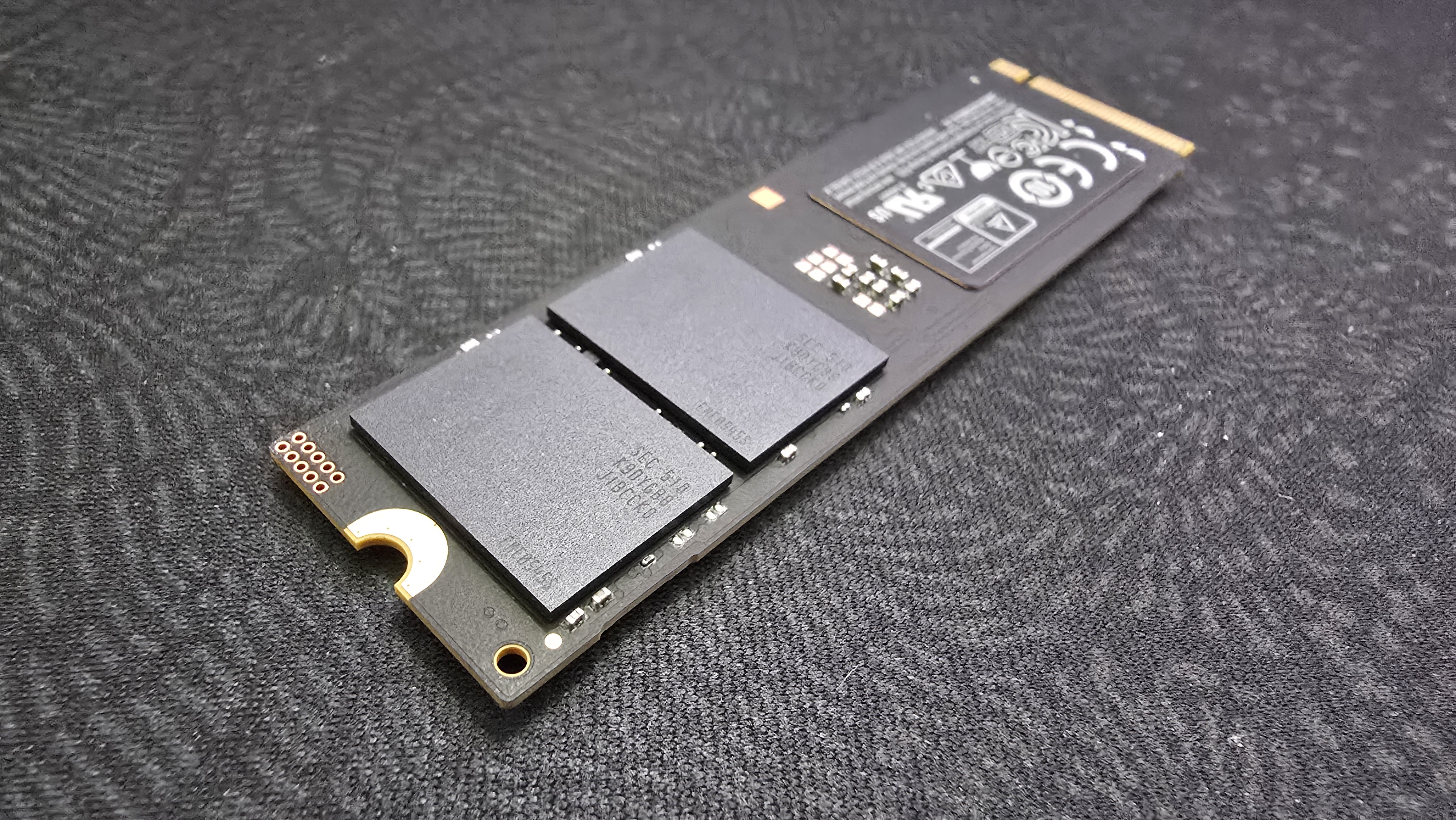
What’s impressive is that all this speed doesn’t come at an unreasonable power cost. Compared to the 990 PRO, throughput nearly doubles while consumption rises only 2.5W. Power efficiency improves nearly 50%, which matters in mobile workstations and laptops that can’t afford runaway draw. Thermals remain under control thanks to the slim heatsink design. Even under hours of heavy write activity, the drive ran cool, avoiding throttling while staying thinner than bulkier competitor designs.
Benchmarks in Practice
Synthetic numbers look good, but the real test is day-to-day usage. The 9100 PRO excelled in 3DMark, cutting game load times significantly. PCMark10 showed noticeable improvements across productivity and creative tasks, especially in image editing and video manipulation. Premiere Pro timelines with massive 8K assets ran smoothly without cache delays. Switching back to a PCIe 4.0 drive made the contrast clear. Load times felt sluggish, transfers crawled, and the responsiveness I had grown used to vanished. PCIe 5.0 is not a small step—it’s a generational leap.
Gamers stand to benefit even if they’re not working with AI or media creation. The PlayStation 5 compatibility makes it a natural console upgrade, and the sheer space means players no longer have to rotate titles in and out. For those who live in massive open-worlds or online libraries, this is the difference between constant management and effortless access. The caveat will be price. PCIe 5.0 drives with this much capacity won’t come cheap, and not every gamer needs 8TB of storage. Lower-capacity models will likely hit a sweeter spot for mainstream buyers.
REVIEW SCORE: 9/10
The Samsung 9100 PRO 8TB is the clearest sign yet of where storage is headed. It doubles down on speed, delivers 8TB of breathing room, runs cooler than expected, and leans into the AI-centric demands of modern computing. Not everyone needs this much drive. Many won’t tap into its full potential, and cost will keep it in enthusiast territory. But for professionals, AI experimenters, and gamers who want a solution they won’t outgrow in two years, it’s unmatched.
For more on Samsung and gaming, follow my socials here – I also stream Mon | Tues | Thurs | Fri @10pm ET over on Twitch, Kick, TikTok, and YouTube

